
Blog
ChatGPT vs. a workforce program tool: what actually differs for resume writing
Andrea Gerson
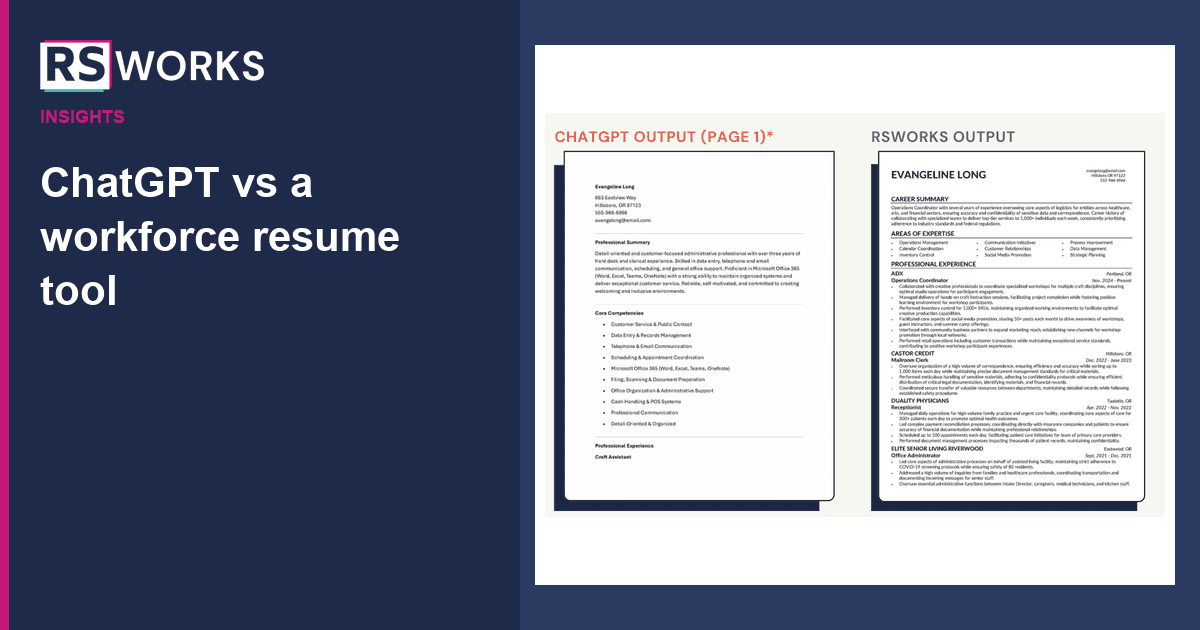
ChatGPT can write a resume. Give it a prompt and a rough history and it will produce something clean and readable in seconds. For one motivated person who knows what a strong resume looks like and will edit closely, that can be enough. For a program moving a caseload toward employment, the gaps between a general model and a tool made for workforce development show up quickly.
Here is the honest version of the comparison.
What ChatGPT does well
It is fast, widely available, and free at the entry level. It follows detailed instructions, and it writes fluently. In our benchmark of general-purpose models, the writing quality was real. The question was never whether these models can string a sentence together. It was whether they produce a resume a coach can send without significant rework, and there they fell short: generic, task-based bullets, quantified results removed, three pages of content for a one-page candidate.
Where a program tool pulls ahead
It starts with intake. A general model works with whatever you hand it, so a thin resume becomes a thin resume in better prose. A tool made for workforce development asks the person about scope, scale, and outcomes before it writes a word, surfacing details they would never think to include on their own. The interview is the actual product. The writing is downstream of it.
Consistency is the next gap. Ask a general model for a resume twice and you get two different documents shaped by how the prompt happened to be worded that day. A program tool runs the same method for every candidate, so a coach carrying thirty cases gets output that reads and looks the same each time, which is what makes review at volume possible.
Career pivots expose the difference most. Repositioning a non-linear history is the hardest part of this work, and general models handle it worst. Translating a warehouse record into the language of a healthcare role, without dropping the person's real experience or inventing experience they do not have, takes a framework the raw model simply does not carry.
Then there is data. Every prompt to a general model passes through the provider's servers. For a program handling participant information at volume, that is often reason enough to stop, and it deserves a close read before a resume with someone's full history goes into a consumer chatbot.
Finally, the layer around the writing. A program needs coach review, an approval step before anything reaches an employer, a staff view of the whole caseload, and pricing that fits an organization instead of a single seat. General models offer none of that, because it was never what they were for.
What counselors see on the other side
Counselors already know the pattern. A participant opens a free chatbot, pastes a messy work history, and gets confident bullets that invent tools, inflate titles, or bury the real story. The appointment then goes to cleaning up fiction instead of coaching barriers, employers, and next steps.
People will still experiment on their phones. Make the licensed path faster and clearer than the public chatbot path, and say plainly what your program will and will not put into consumer AI. A short staff script helps: here is the tool we use, here is why, here is what never goes into ChatGPT.
A practical test for your team: take one real (redacted) participant history and run it through ChatGPT and through your candidate vendor. Score accuracy, hallucination, and how much counselor cleanup remains. If the chatbot wins on speed but loses on truth, it is not winning for a caseload.
The fair conclusion
If you are one person and you will edit carefully, a general model is a reasonable place to start. If you are responsible for a caseload, the resume is only one piece of what you need, and the pieces around it, the intake, the consistency, the data handling, and the coach in the loop, are the difference between a document that looks finished and one that actually moves someone toward a job.