
Most AI resume tools are made for one person polishing one resume. A career services program is a different problem. You are moving dozens or hundreds of people toward employment at the same time, your coaches are reviewing stacks of documents every week, and a funder is waiting on placement numbers. A tool that looks fine in a single demo can create work at scale that you only notice once it is already everywhere.
Here is the test that matters most: could a coach send this document to an employer as written, or would they have to rework it first? If the honest answer is rework, the tool is adding a step to the process instead of removing one.
Below are the things worth checking before you put any tool in front of your coaches and participants.
Does it invent information?
Run a real resume through and read the output for anything the person never gave you. Percentages, dollar amounts, headcounts, and results that appear out of nowhere are the clearest sign a tool is filling gaps with fiction. In our own benchmark, one tool fabricated seven separate metrics in a single resume. Watch for invented jobs, employers, and credentials too. For a participant whose background will be verified by an employer, a fabricated certification is not a formatting issue. It is the reason an offer disappears.
Did the content get stronger, or just get reformatted?
Put the output next to the resume that went in. If the bullets say the same thing in a nicer font, you paid for a template. A tool earns its place when the content itself improves: clearer accomplishments, real scope, numbers that belong to the person. Several tools in our benchmark applied a polished layout over content that never changed, which reads as progress and delivers none.
Is it tailored to the target role?
A resume that could have been generated for anyone applying to anything will not get interviews. This matters most for career changers. Check whether the tool translates a person's existing experience into the language of the role they are pursuing, or whether it strips out the parts that do not obviously match. Losing a candidate's most relevant history because it was not phrased for the new field is a common and expensive failure.
Will it survive an applicant tracking system?
Standard section headers, no text boxes or graphics that ATS software cannot read, clean structure throughout. A bold two-column template can look impressive to a human and still break in the system that screens it first.
What happens to participant data?
Does the tool send names, addresses, and full work histories to a third-party AI model? Is that disclosed? For workforce populations, this is not a detail to sort out later. We covered this in more depth in a separate post on what happens to participant data.
Can staff review before anything reaches an employer?
A program needs a layer where a coach can read, edit, and approve the output. A consumer tool where the participant works alone puts the whole quality question on someone who may be seeing a professional resume for the first time.
How deep is the intake?
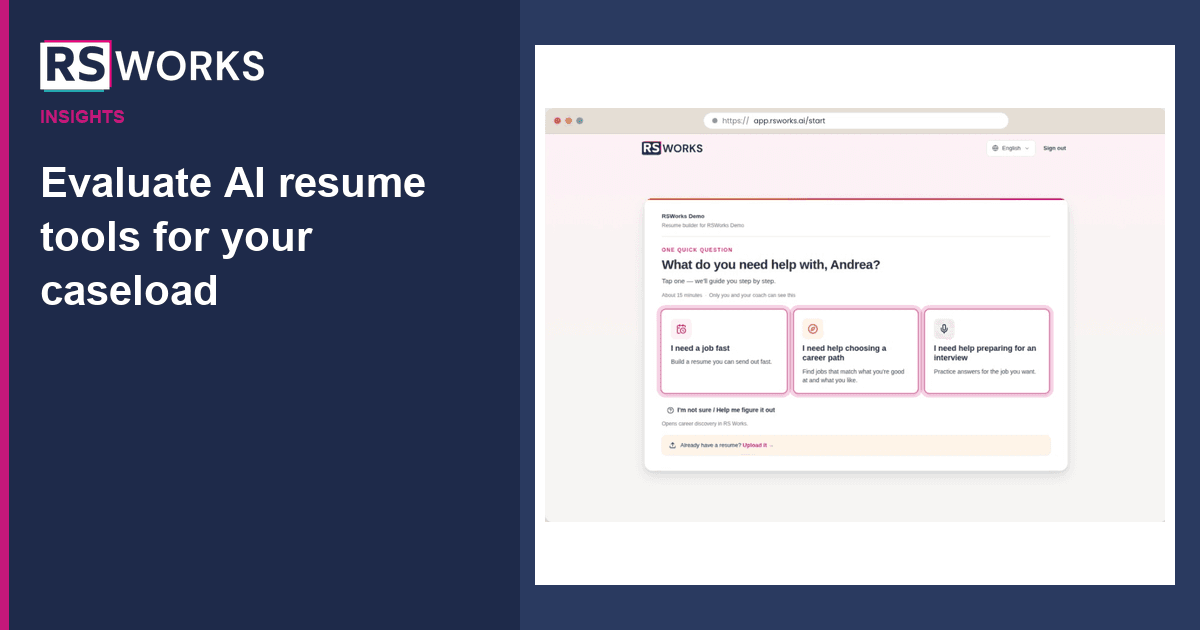
This is the one that decides everything else. Does the tool ask the person targeted questions about their experience before it writes, or does it take the old resume and rewrite what is already there? Thin input produces thin output, no matter how good the model is. The depth of the intake sets the ceiling on the quality of the resume.
A simple way to score it
Take one real participant resume, run it through the tool you are considering, and rate the output against the criteria above. Across our benchmark of 13 tools and 56 outputs, the competitor average came out at 13.9 out of 25. Most tools cleared the low bar of producing a document and missed the higher one: producing a document a coach could actually send.